
Please use this identifier to cite or link to this item:
https://rfos.fon.bg.ac.rs/handle/123456789/107Full metadata record
| DC Field | Value | Language |
|---|---|---|
| dc.contributor.advisor | Jeremić, Veljko | |
| dc.contributor.other | Savić, Gordana | |
| dc.contributor.other | Martić, Milan | |
| dc.contributor.other | Marković, Aleksandar | |
| dc.contributor.other | Bojković, Nataša | |
| dc.creator | Radojičić, Milan | |
| dc.date.accessioned | 2023-05-12T09:46:48Z | - |
| dc.date.available | 2023-05-12T09:46:48Z | - |
| dc.date.issued | 2019 | |
| dc.identifier.uri | http://eteze.bg.ac.rs/application/showtheses?thesesId=7290 | |
| dc.identifier.uri | https://nardus.mpn.gov.rs/handle/123456789/12125 | |
| dc.identifier.uri | https://fedorabg.bg.ac.rs/fedora/get/o:21065/bdef:Content/download | |
| dc.identifier.uri | http://vbs.rs/scripts/cobiss?command=DISPLAY&base=70036&RID=515673754 | |
| dc.identifier.uri | https://rfos.fon.bg.ac.rs/handle/123456789/107 | - |
| dc.description.abstract | Predmet istraživanja ove doktorske disertacije je razvoj metodološkog okvira za unapređenje Analize obavijanja podataka (Data Envelopment Analysis - DEA) korišćenjem Ivanovićevog odstojanja (I-odstojanje) sa reuzorkovanjem, u cilju generisanja granica za virtuelne težine u GAR DEA modelu (Global Assurance Region - GAR). U disertaciji je obrađena problematika merenja efikasnosti složenih sistema, urađen pregled najčešće korišćenih metoda za ocenu efikasnosti i ukazano na prednosti i nedostatke istih. Podržana je ideja ograničavanja težina u DEA metodi. DEA je najčešće korišćena metoda za procenu relativne efikasnosti kompleksnih entiteta koji koriste raznorodne ulaze da bi proizveli raznorodne izlaze. Sloboda u određivanju težina ima za posledicu da će često, značajan broj entiteta biti procenjen kao efikasan, što umanjuje diskriminacionu moć metode. Takođe, pojedini entiteti će biti procenjeni samo na malom podskupu svojih pokazatelja, dok će se ostali pokazatelji ignorisati. Novim modelom se unapređuje nedostatak koji se javlja kod klasičnih modela za ograničavanje težina, gde se granice za težine dobijaju subjektivnom procenom od strane eksperata. Upotrebom I-odstojanja dobija se procena značajnosti, koja je vođena podacima, za svaki od pokazatelja koji učestvuje u proceni relativne efikasnosti. Predloženi model je pokazao konzistentnost i primenljivost kako na profitno, tako i na neprofitno orijentisanim sistemima što je i potvrđeno publikovanjem naučnih radova gde se uz pomoć novog modela procenjuje efikasnost zdravstvenih i bankarskih sistema. Takođe je pokazano da model može uspešno da se primeni i u dvoetapnoj DEA analizi, odnosno i u slučajevima kada postoje pokazatelji koji nisu pod direktnom kontrolom entiteta. | sr |
| dc.description.abstract | The subject of this thesis is the development of a methodological framework for the improvement of Data Envelopment Analysis (DEA) by employing Ivanovic distance (I-distance) with resampling, in order to generate the bounds of virtual weights in the Global Assurance Region DEA model (GAR DEA). The dissertation examined the problems of measuring the efficiency of complex systems. In addition, overview of the most frequently used methods for efficiency evaluation and their particular advantages and disadvantages are provided. The idea of weight restrictions in DEA is elaborated. DEA is the most commonly used method for estimating the relative efficiency of complex entities using various inputs in order to produce various outputs. Freedom in determining the weights have consequences that a significant number of entities will often be perceived to be efficient, which diminishes the discriminatory power of the method. Also, some entities will be assessed only on a small subset of their indicators, while other indicators are ignored. The new model improves deficiency that occurs in classic weight restriction models, where the bounds for weights are obtained by subjective evaluation of experts. Using the I-distance, data-driven, significance assessment is obtained for each of the indicators involved in the estimation of the relative efficiency. The proposed model has shown consistency and applicability to both profit and non-profit oriented systems, which is verified by the publication of scientific papers, where new model has been utilized in efficiency evaluation of banking and health systems. It is also shown that the model can be successfully applied in the two-stage DEA analysis, in cases where indicators exist that are not under the direct control of the entity. | en |
| dc.language | sr | |
| dc.publisher | Univerzitet u Beogradu, Fakultet organizacionih nauka | |
| dc.relation | info:eu-repo/grantAgreement/MESTD/Integrated and Interdisciplinary Research (IIR or III)/47003/RS// | |
| dc.rights | openAccess | |
| dc.rights.uri | https://creativecommons.org/licenses/by-nc-nd/4.0/ | |
| dc.subject | reuzorkovanje | sr |
| dc.subject | ograničavanje težina | sr |
| dc.subject | Ivanovićevo odstojanje | sr |
| dc.subject | efikasnost | sr |
| dc.subject | efikasnost zdravstvenih sistema | sr |
| dc.subject | efikasnost banaka | sr |
| dc.subject | dvoetapna DEA | sr |
| dc.subject | analiza obavijanja podataka | sr |
| dc.subject | weight restrictions | en |
| dc.subject | two-stage DEA | en |
| dc.subject | resampling | en |
| dc.subject | Ivanovic distance | en |
| dc.subject | health efficiency | en |
| dc.subject | efficiency | en |
| dc.subject | Data Envelopment Analysis | en |
| dc.subject | bank efficiency | en |
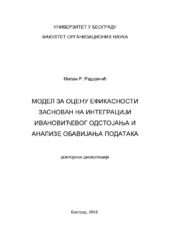
| dc.title | Model za ocenu efikasnosti zasnovan na integraciji Ivanovićevog odstojanja i Analize obavijanja podataka | sr |
| dc.title | Model for efficiency estimation based on the integration of Ivanovic distance and data envelopment analysis | en |
| dc.type | doctoralThesis | |
| dc.rights.license | BY-NC-ND | |
| dc.identifier.fulltext | http://prototype2.rcub.bg.ac.rs/bitstream/id/20/103.pdf | |
| dc.identifier.rcub | https://hdl.handle.net/21.15107/rcub_nardus_12125 | |
| dc.identifier.rcub | t-3541 | |
| dc.type.version | publishedVersion | |
| item.grantfulltext | open | - |
| item.openairetype | doctoralThesis | - |
| item.openairecristype | http://purl.org/coar/resource_type/c_18cf | - |
| item.fulltext | With Fulltext | - |
| item.cerifentitytype | Publications | - |
| Appears in Collections: | Doktorati | |
Page view(s)
114
checked on Jun 9, 2026
Download(s)
28
checked on Jun 9, 2026

Google ScholarTM
Check
This item is licensed under a Creative Commons License
