
Please use this identifier to cite or link to this item:
https://rfos.fon.bg.ac.rs/handle/123456789/1176Full metadata record
| DC Field | Value | Language |
|---|---|---|
| dc.creator | Pešut, Dragica P. | |
| dc.creator | Bursuc, Bogdana | |
| dc.creator | Bulajić, Milica | |
| dc.creator | Solović, Ivan | |
| dc.creator | Kruczak, Katarzyna | |
| dc.creator | Duarte, Raquel | |
| dc.creator | Sorete-Arbore, Adriana | |
| dc.creator | Raileanu, Marinela | |
| dc.creator | Strambu, Irina | |
| dc.creator | Nagorni-Obradović, Ljudmila | |
| dc.creator | Adzić, Tatjana | |
| dc.creator | Lazić, Zorica | |
| dc.creator | Zlatev-Ionescu, Maria | |
| dc.creator | Bhagyabati, Sorokhaibam | |
| dc.creator | Singh, Irom Ibungo | |
| dc.creator | Srivastava, Govind Narayan | |
| dc.date.accessioned | 2023-05-12T10:42:59Z | - |
| dc.date.available | 2023-05-12T10:42:59Z | - |
| dc.date.issued | 2014 | |
| dc.identifier.issn | 2193-1801 | |
| dc.identifier.uri | https://rfos.fon.bg.ac.rs/handle/123456789/1176 | - |
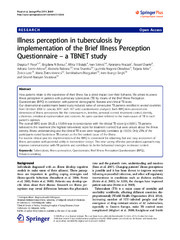
| dc.description.abstract | How patients relate to the experience of their illness has a direct impact over their behavior. We aimed to assess illness perception in patients with pulmonary tuberculosis (TB) by means of the Brief Illness Perception Questionnaire (BIPQ) in correlation with patients' demographic features and clinical TB score. Our observational questionnaire based study included series of consecutive TB patients enrolled in several countries from October 2008 to January 2011 with 167 valid questionnaires analyzed. Each BIPQ item assessed one dimension of illness perceptions like the consequences, timeline, personal control, treatment control, identity, coherence, emotional representation and concern. An open question referred to the main causes of TB in each patient's opinion. The over-all BIPQ score (36.25 +/- 11.054) was in concordance with the clinical TB score (p = 0.001). TB patients believed in the treatment (the highest item-related score for treatment control) but were unsure about the illness identity. Illness understanding and the clinical TB score were negatively correlated (p LT 0.01). Only 25% of the participants stated bacteria or TB contact as the first ranked cause of the illness. For routine clinical practice implementation of the BIPQ is convenient for obtaining fast and easy assessment of illness perception with potential utility in intervention design. This time saving effective personalized approach may improve communication with TB patients and contribute to better behavioral strategies in disease control. | en |
| dc.publisher | Springer International Publishing Ag, Cham | |
| dc.relation | info:eu-repo/grantAgreement/MESTD/Basic Research (BR or ON)/175095/RS// | |
| dc.rights | openAccess | |
| dc.rights.uri | https://creativecommons.org/licenses/by/4.0/ | |
| dc.source | Springerplus | |
| dc.subject | Tuberculosis | en |
| dc.subject | Tobacco smoking | en |
| dc.subject | Questionnaire | en |
| dc.subject | Illness perception | en |
| dc.subject | Brief Illness Perception Questionnaire (BIPQ) | en |
| dc.title | Illness perception in tuberculosis by implementation of the Brief Illness Perception Questionnaire - a TBNET study | en |
| dc.type | article | |
| dc.rights.license | BY | |
| dc.citation.other | 3: - | |
| dc.citation.volume | 3 | |
| dc.identifier.doi | 10.1186/2193-1801-3-664 | |
| dc.identifier.fulltext | http://prototype2.rcub.bg.ac.rs/bitstream/id/80/1172.pdf | |
| dc.identifier.pmid | 25485200 | |
| dc.identifier.rcub | conv_1732 | |
| dc.identifier.scopus | 2-s2.0-84912017874 | |
| dc.identifier.wos | 000359115000001 | |
| dc.type.version | publishedVersion | |
| item.openairetype | article | - |
| item.cerifentitytype | Publications | - |
| item.openairecristype | http://purl.org/coar/resource_type/c_18cf | - |
| item.fulltext | With Fulltext | - |
| item.grantfulltext | open | - |
| Appears in Collections: | Radovi istraživača / Researchers’ publications | |
Page view(s)
66
checked on Sep 6, 2026
Download(s)
30
checked on Sep 6, 2026

Google ScholarTM
Check
Altmetric
This item is licensed under a Creative Commons License
